

Why Job Applications Don't Work And What It's Actually Costing You
The job posting went live on a Tuesday. By Friday, 242 applications had arrived. Most were keyword-optimized, AI-assisted, and structurally indistinguishable from one another. The ATS scored them, ranked them, and surfaced the top 12 for review.
The hire who would have changed everything? Never made it through.
This is not a technology failure. It is a system design failure — one that most companies are still paying for, quarter after quarter, in the form of bad hires, extended vacancies, and strategic talent lost to competitors who recruited differently.

The Core Problem:
ATS Systems Are Built to Filter, Not to Find
Applicant Tracking Systems were engineered to solve a volume problem. They succeeded. They are now extraordinarily efficient at eliminating candidates at scale — including the right ones.
The structure of modern ATS platforms rewards keyword density over demonstrated competence. A candidate who has spent a decade solving the exact problems your company faces will be screened out if their resume doesn't contain the precise phrase your job description used. A candidate who studied the terminology will advance.
This isn't a flaw someone overlooked. It is the logical output of a system whose primary success metric is the reduction of reviewer workload, not quality of hire.
When companies ask why their hiring pipelines feel thin, the answer is rarely "not enough applicants." It is almost always: the infrastructure they built to manage volume is simultaneously destroying signal.
Why Volume Metrics Mask the Real Problem
The KPIs that govern most recruiting functions — applications per role, time to screen, cost per application — are all upstream of the only metric that actually matters: quality of hire at 12 and 24 months.
Recruiters optimizing for speed will always outperform recruiters optimizing for fit — *on the metrics their dashboards show them.* The system doesn't measure what it doesn't track.
The result is a feedback loop that rewards throughput and punishes the slower, more deliberate relationship-building that consistently produces better outcomes.
The Hidden Incentive Structure Behind Broken Recruiting
A posting with 500 applicants signals market demand to stakeholders. It creates the appearance of rigor. It gives talent teams something to report in quarterly reviews.
High application volume almost always indicates poor targeting — roles written too broadly, posted to too many generalist boards, with requirements that were never seriously calibrated. The funnel is wide at the top precisely because nobody did the upstream work to narrow it.
Recruiter Overload as a Structural Feature
The average in-house recruiter today manages 30 to 50 open requisitions simultaneously. At that volume, meaningful engagement with any individual candidate is operationally impossible. The recruiter becomes a process manager, not a relationship builder.
This isn't about the competence of individual recruiters. It is about a staffing model that treats recruiting as a transactional function rather than a strategic one.
The candidates who advance are not necessarily the strongest. They are the ones whose resumes were formatted in a way the ATS could parse, submitted within the window the algorithm favored, and keyword-matched precisely enough to clear the first automated gate.
The SaaS Tool Stack That Made Everything Worse
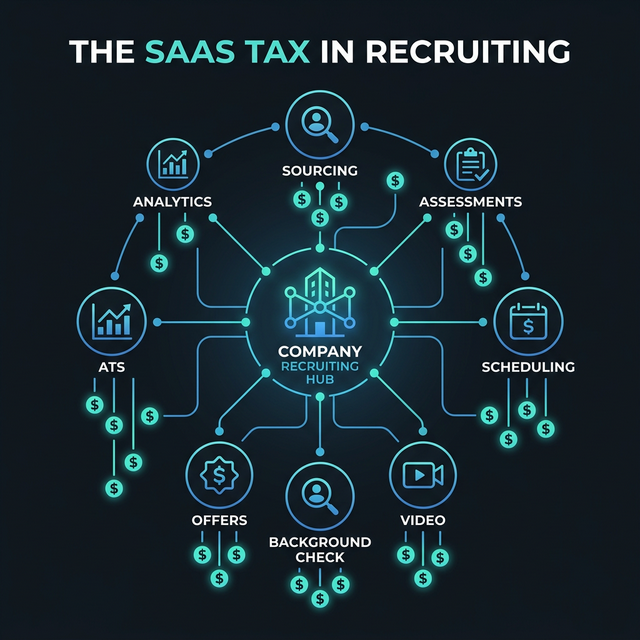
Over the last decade, the HR technology market expanded exponentially. Companies acquired tools for sourcing, screening, assessments, video interviews, background checks, scheduling, and offer management — each solving a narrow problem and creating new integration debt.
The average enterprise recruiting function now runs on eight to twelve separate platforms. Data doesn't move cleanly between them. Candidate experience suffers at every handoff. And the total cost — what we call the **SaaS tax on hiring** — accumulates invisibly in licensing fees, implementation overhead, and recruiter time spent managing tools instead of managing relationships.
The promise was efficiency. The result, in most organizations, is a more complicated version of the same broken process.
The Economic Model Behind the Failure
Here is the uncomfortable truth that most recruiting technology vendors don't want you calculating:
The ATS industry's business model is not aligned with your hiring outcomes. Vendors charge per seat, per requisition, or per user, not per successful placement retained at 18 months. There is no financial incentive for the platform to care whether your hire worked out.
Traditional recruiting agencies face a similar misalignment. Placement fees are typically charged as a percentage of first-year compensation. The incentive is to close the role, not to find the fit. Once the check clears, the relationship ends.
This leaves most companies in the position of paying significant dollars in SaaS subscriptions, agency fees, recruiting headcount, and vacancy costs, for a system that is structurally indifferent to the outcome they actually need.
The math on a single mis-hire at the director level frequently exceeds $200,000 when you account for severance, re-recruitment, team disruption, and delayed execution on the initiatives that role was meant to drive.
What Actually Works Instead
The hiring practices that consistently produce better outcomes share several characteristics. None of them are novel. Most have been de-prioritized in favor of scalable, automated alternatives.
Referral Velocity Over Application Volume
Internal referrals consistently outperform open-market applications across every meaningful quality-of-hire metric. Referred candidates onboard faster, retain longer, and report higher satisfaction. They arrive with a built-in cultural context check from someone who already works there.
The companies that hire well are the ones who treat their referral network as an active recruiting channel — not a passive fallback when the pipeline runs dry.
Building referral velocity requires deliberate investment: keeping former employees warm, staying visible in professional networks before you have a need, and structuring roles in ways that existing team members can describe accurately to their networks.
The Hidden Job Market Is Not a Myth
Research consistently shows that a significant proportion of professional roles — estimates range from 30% to over half — are filled before they are publicly posted. They are filled through conversations: a founder mentioning a need to an investor, a VP texting a former colleague, a department head reaching out to someone they admired at a conference.
This is not an accident. It is a rational response to the dysfunction of the open-market application process.
**High-performing candidates who understand this structure stop competing in the applicant pool entirely.** They invest in being known, trusted, and top-of-mind to the people making hiring decisions before those decisions crystallize.
The same principle applies to employers. The best talent is rarely actively applying. Accessing it requires relationship infrastructure, not job boards.
Fractional Recruiting as a Strategic Model
For startups and growth-stage companies especially, the traditional binary — either hire a full-time recruiting team or engage an agency that optimizes for placement volume — creates a capability gap that costs them disproportionately.
Fractional recruiting solves this structurally. It means embedding experienced recruiting capacity — calibrated to your specific stage, culture, and talent market — without the overhead of a permanent function or the misaligned incentives of a contingency agency.
The fractional model allows recruiting to operate as a strategic function from the first hire, with someone who understands your business deeply enough to actually represent it well in the market.
The Founder Perspective: What This Is Costing You Specifically
Founders and GTM leaders who rely on the standard hiring infrastructure typically experience a version of the same problem: the process surfaces candidates who are good at applying, not necessarily candidates who are exceptional at the work.
At the early and growth stages, every hire compounds. A mis-hire in a senior individual contributor role doesn't just underperform — it shapes the team's culture, influences the next round of hires, and signals something to the rest of the organization about what the company actually values.
The talent that can meaningfully accelerate a Series A or Series B company is not spending its time submitting applications to ATS platforms. It is being recruited — directly, relationally, by someone with the access and credibility to have that conversation.
If your hiring approach depends on inbound applications, you are competing for a subset of the market that is, by definition, actively looking. The candidates who can change the trajectory of your company are, in most cases, not in that pool.
A Better Hiring System: What the Architecture Looks Like
Rather than adding more tools or more volume, the companies that hire well tend to simplify their infrastructure and go deeper on a smaller set of high-signal activities.
The structural components of an effective hiring system:
1. Role clarity before requisition: Defining the actual business problem the hire needs to solve, not just the tasks they'll perform. This changes who you look for and how you evaluate them.
2. Market mapping over job boards: Identifying who in the market has solved this problem before, in a comparable context, rather than waiting for applications to arrive.
3. Outreach with a point of view: Approaching target candidates with a specific, informed perspective on why this role is compelling for them, not a generic pitch that reads like a job description.
4. Structured evaluation, not gut-feel interviews: Designing assessment processes that measure the actual capabilities required, consistently across all candidates.
5. Relationship continuity: Maintaining contact with strong candidates who weren't the right fit at the time, because the market is smaller than it appears and timing matters.
This is not a revolutionary framework. It is recruiting done at the level of care and craft that the function deserves — and that most organizations have optimized away in pursuit of speed and scale.
Book a Hiring Strategy Call with Moonshot
If your hiring process is producing volume but not outcomes — if you are spending on tools and agency fees and still losing top candidates to competitors — the issue is almost certainly systemic, not tactical.
Moonshot Consulting works with startup founders, GTM leaders, and scaling companies to rebuild the hiring function from first principles: relationship-driven, AI-assisted where it adds value, and aligned to the business outcomes that actually matter.
We don't operate on placement fees. We don't optimize for application volume. We optimize for hires that work.
Book a Hiring Strategy Call
The conversation is free. The insight is immediate. And the process is designed to surface what your current system is missing.
Further Reading:
This article was inspired by David Oliver's insights: [The Algorithm Wants You to Apply. It Never Planned to Hire You](https://davidoliver112.substack.com/p/the-ai-gold-rush).
To explore more of David Oliver’s insights on the future of work and recruitment, please visit his Substack: [davidoliver112.substack.com]
